
Table of Contents 1Understanding Authenticity2The Three Aspects of Authenticity Mapping3Assessing Your Authenticity4Deepening Your Relationship with Self5Conclusion Navigating Authenticity: Creating Your Authenticity MapIn a world where vulnerability is championed as the gateway to deeper connections and personal growth, it’s easy to get lost in the labyrinth of authenticity. Brene Brown, a renowned researcher on vulnerability, has shed light on its profound benefits. However, vulnerability without a compass can lead to oversharing, misplaced trust, and a disconnection from our true selves.Understanding AuthenticityAuthenticity isn’t just about being transparent; it’s about aligning our actions, words, and intentions with our core values and true self. To navigate this terrain effectively, we need a map—a tool that guides us through self-reflection and introspection.The Three Aspects of Authenticity MappingIdentifying Your Values: Begin by asking yourself, “What are my values?” List your top 3-5 values—those principles that resonate deeply with who you are and what you stand for. These values serve as the North Star guiding your decisions and actions.Recognizing Your Representative: Reflect on the persona that emerges in moments of anxiety, discomfort, or nervousness. Who is your representative—the version of yourself you present to the world as a shield or facade? Acknowledging this persona is the first step toward embracing your true self.Embodying Your Qualities: Enlist the help of your closest friends and family to identify the qualities that shine brightest when you’re with them. What traits do they admire and appreciate in you? This consensus offers invaluable insight into how others perceive your authentic self.Assessing Your AuthenticityNow that you’ve gathered your insights, it’s time for introspection:Living in Alignment: Evaluate whether your actions and choices reflect your core values. Are you living in line with what truly matters to you, or have you veered off course?Reassessing Your Representative: Question the necessity of your representative. Can you drop the facade and embrace your true self more deeply? Challenge yourself to step into authenticity, even in moments of vulnerability.Embracing Your Embodiment: Are you fully embodying the qualities recognized by your loved ones? If not, set the intention to cultivate and nurture these traits within yourself.Deepening Your Relationship with SelfAuthenticity isn’t a destination; it’s a journey of self-discovery and acceptance. To deepen your authenticity:Self-Reflection: Continuously ask yourself how authentic you truly are. Explore areas where you may be holding back or wearing masks, and commit to unveiling more of your genuine self.Inner Work: Engage in practices that foster self-awareness and self-love. Whether it’s journaling, meditation, or therapy, prioritize activities that nurture your relationship with yourself.ConclusionCreating an authenticity map isn’t about achieving perfection; it’s about cultivating awareness and embracing your journey toward authenticity. By aligning with your values, shedding your representative, and embodying your true qualities, you pave the way for deeper connections, fulfillment, and self-discovery. Remember, the key to authenticity lies in accessing the fullness of who you are.

Nurturing Connections: 3 Practical Ways to Co-Regulate in All Your Relationships
Table of Contents 11. Active Listening: The Gift of Presence22. Emotional Check-Ins: Honoring Feelings33. Co-Regulate Through Breathing and Mindfulness:4Conclusion: Fostering Connection Through Co-Regulation While we often associate co-regulation with romantic partnerships, it’s a vital skill that can enhance all meaningful connections in our lives. Co-regulation, the process of mutually regulating emotions to create a sense of safety and trust, can deepen bonds, foster understanding, and promote emotional well-being. In this blog post, we’ll explore three practical ways to co-regulate in all your important relationships.1. Active Listening: The Gift of PresenceActive listening is a cornerstone of co-regulation in any relationship. It involves fully engaging with the other person, not just hearing their words but also understanding their emotions and perspectives. Here’s how you can practice active listening:- Be Fully Present: When someone is sharing their thoughts or feelings with you, put aside distractions and give them your undivided attention. Maintain eye contact, nod, and use verbal cues like “I see” or “Tell me more” to convey your attentiveness.-Empathize, Don’t Sympathize: Seek to understand the other person’s emotions and experiences from their perspective. Instead of immediately offering solutions or sharing your own similar experiences, validate their feelings by saying things like “It makes sense that you feel that way.”-Reflect and Clarify: Periodically summarize what the person has said to ensure you’ve understood correctly. For example, “So, you’re feeling frustrated because of the miscommunication at work?”Active listening not only promotes co-regulation but also strengthens emotional bonds by making the other person feel heard and valued.2. Emotional Check-Ins: Honoring FeelingsEmotions are the threads that weave our human experiences together. Incorporating emotional check-ins into your relationships can facilitate co-regulation and create an environment where emotions are acknowledged and honored:-Regularly Ask How They’re Feeling: Make it a habit to check in with your loved ones and ask how they’re feeling. Avoid generic questions like “How are you?” Instead, be specific, like “How are you feeling about your upcoming presentation?”-Create a Safe Space: Ensure that your loved ones feel safe sharing their emotions with you, even if those emotions are negative. Avoid judgment or criticism, and let them know you’re there to support them, no matter what they’re feeling.-Share Your Own Feelings: Modeling emotional vulnerability can encourage others to do the same. When you share your own feelings openly and honestly, you create a space for reciprocity and deeper connection.3. Co-Regulate Through Breathing and Mindfulness:Breathing and mindfulness exercises are effective tools for co-regulation in any relationship:-Practice Together: When you notice tension or heightened emotions in a conversation, suggest taking a few deep breaths together. Inhale for a count of four, hold for four, and exhale for four. This simple exercise can help calm the nervous system and create a sense of shared calm.-Mindful Presence: Encourage moments of mindfulness in your interactions. For example, during a walk, suggest focusing on the sights, sounds, and sensations around you. This can ground both of you in the present moment and reduce stress.-Learn Together: Explore mindfulness practices or meditation as a shared activity. You can attend mindfulness classes, download meditation apps, or simply set aside time for quiet reflection together.Conclusion: Fostering Connection Through Co-RegulationCo-regulation isn’t reserved for romantic partnerships; it’s a fundamental aspect of all meaningful relationships. By actively listening, practicing emotional check-ins, and incorporating breathing and mindfulness exercises, you can foster deeper connections and emotional well-being in every important relationship in your life. Remember, the symphony of connection is harmonized through mutual understanding, empathy, and the shared journey of co-regulation.

Pushing Away Love: How Unmet Childhood Needs Shape Our Lives
In the intricate web of human connections, love serves as the fundamental bond that ties us together. However, for some individuals, the inclination to push love away is more than just a passing behavior—it’s a reflection of deeper, unaddressed needs from their early years. During childhood, our caregivers play a crucial role in shaping our perceptions of love and our ability to form healthy relationships. Messages conveyed by parents or caregivers, whether consciously or unconsciously, can profoundly impact how we perceive our own needs. For some, growing up in environments where expressing needs was discouraged or met with dismissal can result in the internalization of the belief that their needs are insignificant or burdensome. Imagine a child whose requests for attention or support are consistently overlooked or rejected by their caregivers. Over time, they may internalize the message that their needs are not valid or worthy of acknowledgment. This sets the stage for a pattern of avoidance in adulthood, where individuals struggle to recognize, let alone articulate, their own needs in relationships.The avoidance of love or intimacy becomes a defense mechanism—a way to protect oneself from the perceived pain of rejection or neglect. Despite a genuine longing for connection, individuals with avoidant tendencies may find themselves instinctively pushing away potential partners, fearing vulnerability and the potential disappointment of unmet needs. The prevalence of avoidant behavior in the dating world is a testament to the enduring impact of childhood experiences on adult relationships. These individuals may yearn for love and connection but find themselves trapped in a cycle of self-sabotage and emotional detachment. Breaking free from this cycle requires a willingness to confront the discomfort of unmet needs and embark on a journey of self-discovery. It involves recognizing and challenging the deeply ingrained beliefs about one’s worthiness of love and support. It’s about learning to identify and communicate one’s needs effectively, both to oneself and to others.Receiving love and nurturing is not a sign of weakness but a fundamental human need. It requires vulnerability and courage to dismantle the emotional barriers erected over time. Only by acknowledging and addressing these unmet needs can individuals pave the way for healthier, more fulfilling relationships. To those who find themselves pushing love away, know that you are not alone. Your actions are not a reflection of your inability to love but rather a manifestation of the unmet needs longing to be acknowledged and healed. Embrace the discomfort, embark on the journey of self-discovery, and reclaim the love and connection you deserve.

Cultivating Healthy Connections: Nurturing Relationships Mindfully
Table of Contents 11. Slowing Down: The Art of Mindful Connections22. Managing Early Relationship Anxiety33. Taking Time to Get to Know Someone44. Regulating Fear of Rejection and Fear of Not Being Liked55. Cultivating Self-Compassion6Conclusion Creating healthy connections with others is essential for our emotional well-being and personal growth. In our fast-paced world, where social interactions often occur online and relationships can feel fleeting, it’s crucial to slow down and cultivate connections mindfully. In this blog post, we will explore practical strategies to foster healthy relationships, including slowing down, managing early relationship anxiety, taking time to get to know someone, and regulating common fears like the fear of rejection and not being liked.1. Slowing Down: The Art of Mindful ConnectionsIn our eagerness to connect, we often rush into relationships without taking the time to truly understand the other person.Slowing down allows us to be present in the moment, appreciating the subtleties of the other person’s character. By being mindful, we can observe their actions, words, and gestures, gaining a deeper understanding of who they are beyond the surface level. Being attentive to people’s actions and behaviors, rather than solely relying on their words, provides invaluable insights into their core values and true character. When forging significant connections, it’s crucial to recognize the significance of the person’s value system since these values serve as the compass directing their actions.2. Managing Early Relationship AnxietyIt’s natural to feel anxious at the beginning of a new relationship. Uncertainty and the fear of the unknown can trigger anxiety.Acknowledging these feelings is the first step. When mindfully building connections, it’s vital to acknowledge that anxiety can impede our ability to proceed deliberately. This anxiety often steers our focus towards worrying about whether the other person likes us, rather than effectively managing our own anxious feelings and truly assessing if we genuinely like them. Managing early relationship anxiety can provide a distinct advantage in the art of connection-building. When you can confront and sit with the discomfort and uncertainty that often accompanies new connections, this opens the door to generating shared experiences and finding common ground with those you meet. This ability to embrace the unknown enables you to engage more authentically and deepen our relationships, as we learn to navigate the initial anxiety and foster genuine connections based on shared experiences and relatability. 3. Taking Time to Get to Know SomeoneHealthy connections are built on understanding and acceptance. Take the time to ask meaningful questions and actively listen to the other person’s responses. Show genuine interest in their life, experiences, and dreams. Avoid making assumptions and allow them to reveal themselves at their own pace. Additionally, it’s crucial to gauge the other person’s level of general interest in you and observe their active engagement in the conversation. Remember, meaningful connections are nurtured through shared experiences, open communication, and mutual respect.4. Regulating Fear of Rejection and Fear of Not Being LikedFear of rejection and not being liked are common concerns that can hinder our ability to form healthy connections. It’s important to recognize that rejection is a natural part of life, and it doesn’t define your worth as a person. Rejection, although often painful, serves as a valuable source of information in our quest to find our people. When someone isn’t interested in you, it’s a powerful reminder that you possess the ability to discern who genuinely aligns with your values and aspirations. This experience can be transformative, as it empowers you to make a resolute declaration to yourself: to invest your precious time and energy solely in those who not only recognize but also deeply appreciate your true worth. In this way, rejection becomes a catalyst for personal growth and the formation of meaningful, authentic connections.5. Cultivating Self-CompassionBuilding healthy connections starts with cultivating a compassionate relationship with yourself.Be kind and understanding toward your own vulnerabilities and imperfections. Acknowledge that you are worthy of love and belonging just as you are. When you approach relationships from a place of self-compassion, you’re better equipped to handle challenges and setbacks with resilience and grace. Being compassionate toward yourself is a remarkable superpower in social situations. It grants you the strength to engage with people you may have never interacted with before, as it erases the isolating feeling of being alone in challenging social settings. When you are there for yourself with kindness and understanding, you build a self-assured foundation that allows you to approach conversations with confidence, knowing that you can rely on your own support. This self-compassion becomes a bridge to connect with others, forging connections and creating a more inclusive, less intimidating atmosphere.ConclusionCreating healthy connections requires patience, understanding, and self-awareness. By slowing down, managing early relationship anxiety, taking the time to truly know someone, and regulating fears of rejection and not being liked, you can foster genuine and meaningful relationships. Remember that healthy connections are based on mutual respect, trust, and acceptance. As you nurture these qualities within yourself, you’ll naturally attract the kind of connections that enrich your life and contribute positively to your well-being.

Beyond “I’m Triggered”: Harnessing Triggers for Personal Healing
Table of Contents 1Beyond “I’m Triggered: Harnessing Triggers for Personal HealingRecognizing the TriggerMoving Beyond “I’m Triggered”1. Self-Reflection:2. Explore the Root Cause:3. Embrace Emotional Processing:4. Seek Support:5. Reclaim Your Power:The Transformative Potential Beyond “I’m Triggered: Harnessing Triggers for Personal HealingIt is not uncommon in today’s language to hear someone say, “I am triggered.” However, we frequently fail to recognize the significant potential concealed within those triggering moments. This blog post will explore the idea that you can use your knowledge of what triggers you as an effective tool for personal growth and healing.Recognizing the TriggerLet’s start by defining what triggers are before we delve into their transformative potential. Triggers are emotional responses that we have in reaction to specific stimuli. They are often linked to past experiences or unresolved emotions and can result in feelings of anger, fear, sadness, or anxiety. Triggers are usually triggered when something in the present reminds us of a painful past event.Moving Beyond “I’m Triggered”Acknowledging that you are triggered is a crucial first step in emotional self-awareness, but it’s only the beginning of the journey toward healing and growth. You can harness the knowledge of your triggers for your benefit.1. Self-Reflection:When you feel triggered, pause and reflect. Ask why this situation caused a strong reaction. What past experiences or emotions are contributing?2. Explore the Root Cause:It’s important to explore the root causes of our triggers, as they can be linked to past traumas or significant life events. By understanding these sources, we can gain profound insights into our emotional landscape.3. Embrace Emotional Processing:Processing and releasing emotions triggered is crucial for healing, allowing full experience of feelings.4. Seek Support:Healing from triggers doesn’t have to be a solitary journey. Therapists, coaches, or support groups can provide valuable guidance and a safe space to explore your triggers and their underlying causes.5. Reclaim Your Power:By becoming more aware of your triggers and working through the emotions associated with them, you regain control over how you respond. You are no longer a prisoner of your triggers, but rather, the master of your reactions.The Transformative PotentialUnderstanding and working through your triggers can lead to self-empowerment and emotional freedom. It helps you heal the parts of yourself that react to triggering stimuli. By doing so, you’re not just addressing the surface-level reaction but also dealing with the underlying wounds that cause your triggers. Through the process of self-discovery and healing, you have the power to move beyond simply acknowledging when you are triggered. Instead, you can use your triggers as a guide towards deep personal growth and emotional resilience. Keep in mind that within each triggering moment lies the potential for healing, self-compassion, and transformation.
Fair Fighting Rules Checklist
If you find that conflicts in your relationship escalate into larger problems, then fair fighting rules are for you! You will benefit greatly from establishing guidelines for how to handle disagreements when emotions run high. It can be easy to say things in the heat of the moment that you later regret. You or your partner may say hurtful things without even realizing it, and later when it’s calm, may feel guilty or ashamed for what was said. Other times, you or your partner may intentionally say hurtful things to try to gain an advantage in the argument. Regardless of the intent, the effects of hurtful language can be damaging to the relationship, causing emotional pain, mistrust, and resentment. When arguments escalate they tend to become more personal, emotions intensify, communication breaks down, and the conflict becomes more difficult to resolve. Fair fighting rules act as an insurance policy to get you and your partner to avoid falling into the escalating arguments trap and without clear rules for communication, the same pattern will repeat leaving the two of you feeling drained and defeated. Use this checklist to establish the fair fighting rules that fit your relationship. Continue Reading…CHECKLIST: If you answer yes to any of the questions, choose a rule or two from the list in the right column to discuss with your partner!When arguing do unresolved past problems, previous events, and past examples of “how this always happens” get brought up? Then try one of these:Agree to keep it simple stay on the current problem.Agree to avoid dredging up past issues in the moment. If past memories come up make it a point to set aside time to discuss any unresolved hurt from the past when you are both calm. Stay away from “you always” “you never” “oh here we again” “It’s just like you to bring this up.” “You are constantly taking issue with me.”Do you or your partner take things personally? Do you wall up and defend yourself? Do you feel like your partner consistently has problems with you, not the relationship but you? If you answered yes to any of these, these examples may be for you:Agree to verbalize when you start to take things personalNo blaming language, “you do this” You are this,” etc.Agree that when one person says they feel attacked, the other person takes a step back, a deep breath, and rephrase to come from a loving place.Agree to speak from “I,” say “I felt _____,” “I need,” “When this happened I felt ______”Are either of you making impossible demands? Do you or your partner make demands that you simply can’t fulfill? Agree to generate more realistic expectations and requests in your relationship.Change demands to requestsLet go of attachment to the request to avoid disappointmentIf you get disappointed tell your partner in a non-blaming way. Ask your partner if a request is realistic. Agree to use your partner as a sounding board. Do you get caught up in the facts of what happened when you were fighting? Do you waste precious energy trying to convince your partner what you saw happened? Agree to stay curious about your partner’s experienceAgree to look for the emotions and discuss how you felt during the eventAgree to avoid the urge to find a solution right awayAgree to look for the other person’s unmet need or desireDo you or your partner feel criticized or judged during disagreements? Agree to say how you feel without pointing the fingerAgree to make a positive request to your partner that would solve or improve the current problemAgree to ask for what you want in a positive wayDo you or your partner shut down and resort to name calling? Do you or your partner dismiss the other person’s thoughts or feelings?Agree to stay open to understandAgree to listen and avoid thinking about what you are going to say nextAgree to make every effort to get back to center and come from a loving placeAgree to take a break if you are unable to self sootheAgree to use this mantra: “My partner wants the best for me, they are not trying to hurt to me.”Do you or your partner get so heated you can’t calm down?Agree to take a timed breakAgree that when a break is taken you will come back to discuss Agree to avoid using a break to hurt the other personAgree to reassure your partner you love them and you will return to discuss.Three Steps to Setting the Stage 1Choose a Neutral Time It’s important to choose a mutually agreed upon time and place when you can focus and are free from distractions. 2Set Your IntentionsApproach the conversation with a positive intention to improve the relationship. Acknowledge that each rule you set is meant to improve communication and prevent hurtful comments. 3Collaborate to Create the Rules Work together to create the rules that work for both of you. Make the commitment that you will allow the other to hold you accountable and bring you back to the rules when things get heated in future arguments. Remember, the goal of establishing fair fighting rules is to improve communication and prevent hurtful comments. By working together to create rules that are respectful and constructive, you build a stronger, healthier relationship and you will know you can work through conflicts in a positive way. Leaving you feeling satisfied and content in your relationship!
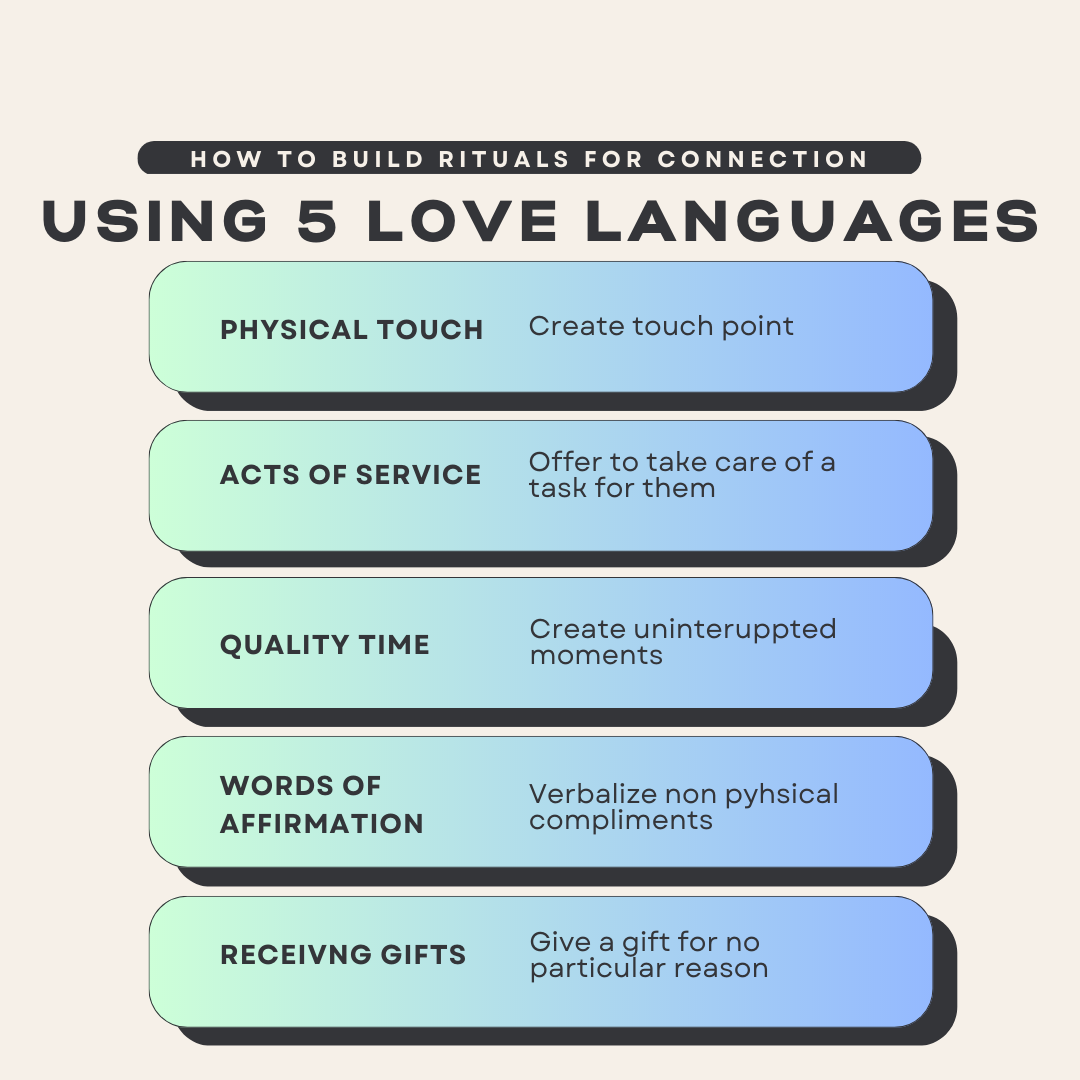
How to Build Rituals for Connection Using the 5 Love Languages
Table of Contents If you don’t know your or your partner’s love language, click here to take the quiz.Physical TouchActs of ServiceQuality TimeWords of AffirmationReceiving Gifts If you don’t know your or your partner’s love language, click here to take the quiz. Use the 5 love languages as an anchor point to learn how to build connection in your relationship. This can be a helpful tool for building connection because you can start to understand how to communicate love in the way your partner will receive and appreciate it. You do this by learning which love language is most important to your partner and tailoring your actions to show love in the way that is most meaningful to them. When you communicate love in a way that is received well, it creates a positive cycle of giving and receiving that can strengthen your relationship. Not to mention, using the 5 love languages as a guide, brings the concept of connecting to your partner to real actionable steps. So often I see couples get overwhelmed by not knowing where to start when trying to tackle creating more connection. Use this post as a guide to practice connecting with your partner in different ways. I have broken down each love language with specific examples of how to create a connection, hope this is helpful!! Physical Touch If you or your partner receive love this way, you get to communicate love and connection through nonverbal communication. Physical touch takes the guessing out of what to say or do. All you have to do is remember to touch your partner. Learn how to move into non-sexual touch. So often partners complain that their partner initiates touch solely with sexual advances attached. Learn to give affection from a loving, comforting place. Where you are giving your partner the messages, “I am here,” “I love you,” “I appreciate you,” and “You are safe.” A loving gaze or intentional eye contact can convey the same message without the use of words. Find time to give unexpected hugs, place your hand on their shoulder, rub their back, or put your hand on their knee. All of these convey a message of assurance and love. Acts of Service If you or your partner receive love this way, you get to communicate love and connection through action. Action shows your partner, that you are listening to them, you are considering them and you want to be a part of the relationship. You show your partner you are a team through acts of service. Here are some examples; preemptively complete a household chore when you get home or wake up in the morning i.e., dishes, laundry, straightening toys, etc. Offer to run errands. i.e., grocery shopping, dry cleaning, and picking the kids up from school. Actions are a great way to show your partner you are committed to the relationship and that you do not take your partner for granted. Jumping into tasks around the house or taking care of errands can seem like doing your duties as a partner but if your partner receives love this way, you will find they will feel more assurance in the relationship and will feel more connected to you. Quality Time If you or your partner receive love this way, by spending quality time together you get to create uninterrupted moments with your partner. These moments convey the message, “You are important,” “I value what you have to say,” and “I respect and appreciate you.” When you create these uninterrupted times together and give your undivided attention to your partner, they will feel secure in the relationship and will know that you prioritize and value connecting with them. Here are some examples; create time with no distractions, initiate a shared activity; movie, beach walk, hike, play a game, movie, etc. Spend evenings sharing a glass of wine or tea and sharing about the day. Surprise your partner with a dinner or a Saturday morning, just the two of you free of distractions. Words of AffirmationIf you or your partner receive love this way, by hearing affirming and loving words, you get to consistently tell your partner how much they mean to you. Take note of the ways your partner surprises you or makes you proud and verbalize this to them. Give your partner that gift, where they hear how much you treasure, value, and honor who they are as a person. If your partner receives love this way you will see that by using affirming words, they light up. You will witness them soften and turn toward you more often. When you use words of affirmation you are conveying the message, “I see you.” This provides them with the feeling they are loved and supported by you. Here are some examples; encourage them by telling them you are proud, believe in them, etc. Use affectionate words such as “I love you” or express how much they mean to you, and remind them of their strengths, and their resilience. Receiving GiftsIf you or your partner receive love this way, by receiving gifts, they feel most loved by you when they know you have thought of them. Gift gifting is an act of thoughtfulness. This gives your partner the message that they are thought of even if they aren’t around. Your partner will feel that they are valuable and worth paying attention to. When you give your partner gifts they are receiving connection, love and ultimately the acknowledgment that they are important. Here are some examples; give your partner a thoughtful gift that shows you were paying attention to their interests, needs, or desires. Give a symbolic gift, something that symbolizes a time in your relationship. Give the gift of experience and plan a day trip. Give a gift for no particular reason to show you were thinking of them.

5 Ways to Create a Deeper Bond in Your Relationship
Table of Contents Identify your Shared Values: Discuss your Goals and Aspirations: Create Shared Rituals and Traditions: Develop a Shared Language:Cultivate a Sense of Gratitude: 1Click Button to Download Needs Wheel and Get Started!Find Your Shared Values Today! One of the best ways to create a deeper bond with your partner is by aligning shared visions. This means working together to create a mutual understanding of what you want to achieve together in the future. It involves setting shared goals and aspirations and ensuring that your visions for the future are in harmony with each other. When you develop purpose together, you direct your energy to the places where it can be most effective, thus generating a clear direction forward. It involves being on the same page and making sure that both partners feel supported and encouraged to pursue their goals while also prioritizing the relationship. This is where a couple becomes a powerhouse, joining forces, and learning how to support and align with the other. Where your attention goes, energy flows. Here are 5 tips to create a shared vision in your relationship:Identify your Shared Values: Download the needs wheel (at the bottom of this blog post) and go through it with your partner. Identify individually your top 10 values for the relationship, then compare. Have an open and honest conversation with your partner to identify and fine-tune what the top 5-10 foundational values for your relationship are. This will help you establish a foundation of shared beliefs that can guide your decision-making as a couple. Shared values can become an anchor bringing you back to what is most important in your relationship. Discuss your Goals and Aspirations: Set aside time to generate discussion about your individual goals and aspirations. Share and explain why they are important to you, be clear about what you hope to achieve and how they fit into your overall vision for the future. Ask questions and express curiosity about their ideas and why they are important to them. Look for areas where your goals and aspirations overlap and identify shared values or interests. Set realistic and achievable milestones and support each other in working towards them. Create Shared Rituals and Traditions: Relationship rituals are activities or behaviors that are unique to a couple and can be anything from shared hobbies, date nights, celebrating milestones to daily check-ins. Establishing shared rituals and traditions can be a powerful way to build connections and strengthen your sense of feeling aligned. Start by identifying activities that you both enjoy or are interested in trying. This could be something as simple as cooking a meal together or going for a walk in the evening. Above all, keep your shared rituals and traditions fun. They should be a source of joy and connection, not a chore or obligation. Develop a Shared Language:Find the time to define key terms and concepts that are important to both of you, this can help ensure that you have a shared understanding of what you’re talking about. Also, set aside time to learn each other’s communication styles and preferences. This can help you tailor your approach and improve your communication. Get in the habit of using shared language or code words that only you and your partner understand, this is a fun way to create a sense of intimacy and understanding between you. Cultivate a Sense of Gratitude: Start by making a conscious effort to express gratitude towards each other regularly. Focus on the positive, and highlight the areas where they did well, or surprised you, this could be things like your partner’s sense of humor, their willingness to listen, or their thoughtfulness. Practice active listening, this shows that you care about their thoughts and feelings by asking questions and responding thoughtfully. Appreciate the positive qualities and actions of your partner, this helps to build a sense of shared meaning and appreciation for one another. By implementing these tips and regularly checking in with each other, you can develop a deep bond that strengthens your focus, drive, and purpose! Leave a comment below with any thoughts or questions you may have! Click Button to Download Needs Wheel and Get Started!Find Your Shared Values Today! Click Here Now To Download
How To Create Emotionally Safe Dialogue
Do you want to feel secure, supported, and accepted in your relationship? Do you want to feel comfortable expressing your thoughts and emotions without fear of judgment, rejection, or retaliation?Create emotional safety in your relationship. This is achieved by both partners striving to create a safe and supportive environment. When you decide to be intentional in your relationship you work to take ownership of your own emotions and work on your personal growth to improve your relationship. This tool will allow you to be vulnerable and learn how to be open with each other, you will learn to trust that your emotional needs will be acknowledged and respected. Emotional safety once cultivated, creates a sense of trust and intimacy, which is essential for building a deep and meaningful connection. Here is a powerful tool to improve connection and to create emotional safety and the steps to take: Schedule a time: Find a time when both you and your partner are available, and make sure you won’t be interrupted. Set the stage: Find a quiet and comfortable place where you can sit facing each other. Begin by taking a few deep breaths and relaxing your body. Mirroring: One partner speaks while the other listens without interruption or judgment. The listener then summarizes what the speaker has said, using the same words if possible. For example, “So what I hear you saying is…” This helps the speaker feel heard and understood. Validation: The listener then validates the speaker’s feelings by saying something like, “I can understand why you feel that way.” Empathy: The listener then tries to put themselves in the speaker’s shoes and imagine how they would feel in that situation. They can say something like, “If I were in your position, I would feel…” Switch roles: Once the speaker feels heard and validated, the roles are switched and the other partner gets a chance to speak and be heard. Dialogue: Once both partners have had a chance to speak and be heard, they can engage in a dialogue about how to move forward and find a resolution. By following these steps, you can create a safe space for communication. This is the tool to help you work through your differences in a respectful and empathetic way. This approach will help you build trust, which is essential for a healthy and fulfilling partnership. It’s important to remember this is a process, and it may take some time to get used to. It’s also important to approach the conversation with an open mind, a willingness to listen, and a commitment to finding a resolution. With practice, you will deepen emotional intimacy in your relationship.
Ways Attachment Issues Can Affect Your Connection With Your Partner
Table of Contents If you have an insecure attachment style: If you have an avoidant attachment style:If you have an anxious attachment style:If you have experienced betrayal or abandonment in past relationships: Conclusion During the early stages of development, you form an emotional bond known as attachment. This bond serves as a guide that your body uses to identify feelings of safety, love, and connection throughout your life. Attachment can be seen as the means through which we establish connections with others in relationships. Attachment issues can have a significant impact on the way you connect to your partner. Attachment theory suggests that our early relationships with our primary caregivers shape our ability to form and maintain healthy attachments with others throughout our lives. Here are some ways attachment issues can affect your connection with your partner:If you have an insecure attachment style: you may struggle with emotional intimacy and have a hard time opening up to your partner. You may fear rejection or abandonment, which can make it challenging to form a deep connection with your partner. This fear can become primary for you and blocks your body’s ability to soften into connection. If you have an avoidant attachment style: you may fear becoming too dependent on your partner or losing your independence. This fear can lead to a tendency to withdraw emotionally and avoid closeness with your partner. The need for independence can be so strong in you that you prioritize this over love and bonding. That is because the way you stayed safe when you were younger was to create distance between you and your primary attachment figures.If you have an anxious attachment style:you may struggle with boundaries in your relationship. You may have a fear of abandonment and seek constant reassurance from your partner, leading to clingy behavior and a lack of personal boundaries. If you are anxiously attached you may crave love but block yourself from reaching that true connected feeling because the fear of abandonment is so loud, that you settle for reassurance and sacrificing your boundaries to feel some modicum of safety. If you have experienced betrayal or abandonment in past relationships: you may struggle with trust issues that make it challenging to connect with your partner on a deep level. Your senses can be heightened and your body spends more time scanning for possible mistrust than creating connection.Conclusion Individuals with attachment issues may struggle with resolving conflicts healthily and constructively. They may avoid conflict or become overwhelmed and reactive when triggered. Conflict can provoke your attachment reactivity and instead of showing up embodied and grounded, your body’s attachment takes over and you show up in attachment fear either avoiding or becoming so overwhelmed the conflict goes unresolved.If attachment issues arise in your relationship, it’s important to work on developing a secure attachment style to improve your connection with your partner. This may be achieved through relationship coaching or couples counseling. Relationship work can empower your relationship through processing past experiences, nervous system regulation, and integration practices! You will develop healthier patterns of relating to your partner that bring you into a more satisfying relationship.