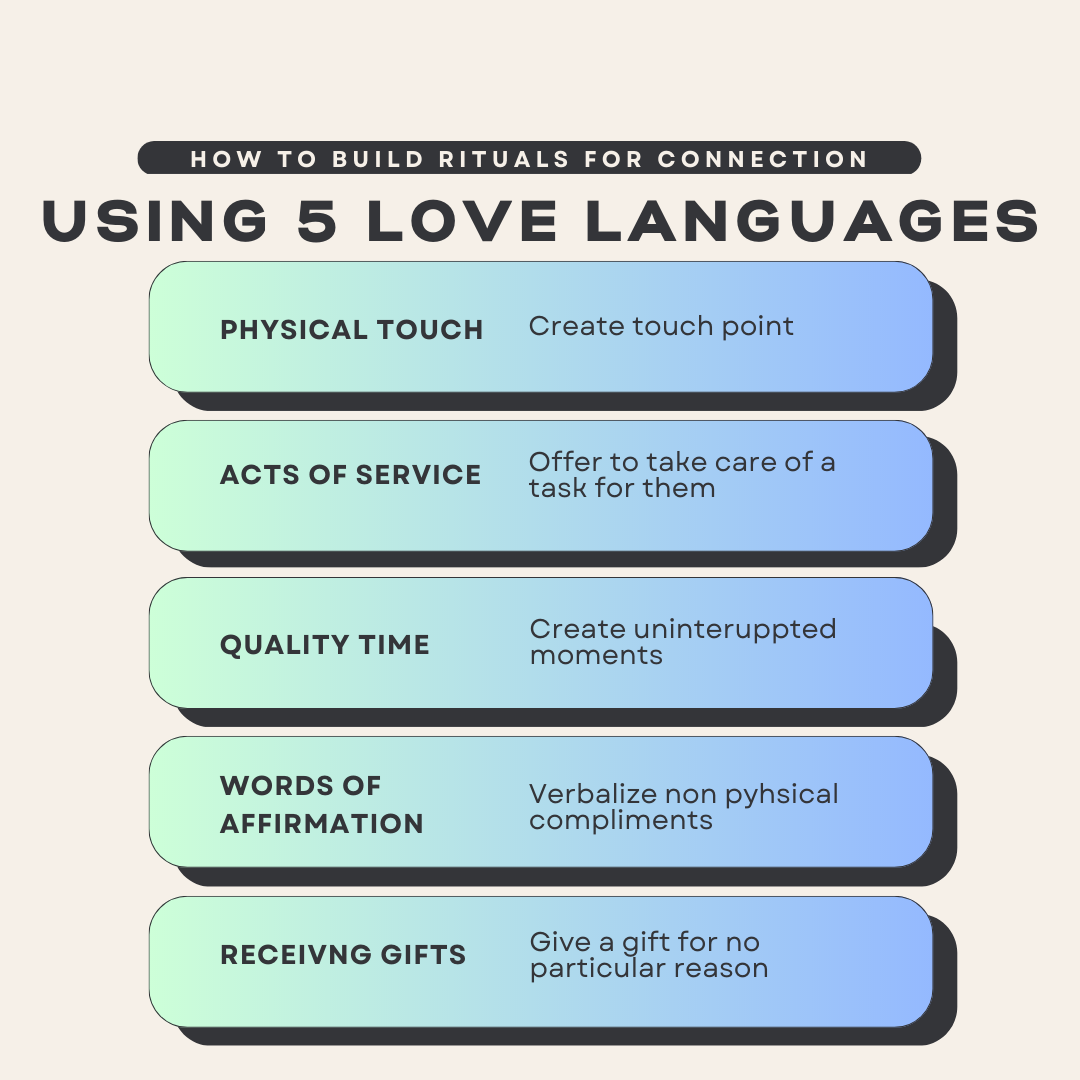
Table of Contents If you don’t know your or your partner’s love language, click here to take the quiz.Physical TouchActs of ServiceQuality TimeWords of AffirmationReceiving Gifts If you don’t know your or your partner’s love language, click here to take the quiz. Use the 5 love languages as an anchor point to learn how to build connection in your relationship. This can be a helpful tool for building connection because you can start to understand how to communicate love in the way your partner will receive and appreciate it. You do this by learning which love language is most important to your partner and tailoring your actions to show love in the way that is most meaningful to them. When you communicate love in a way that is received well, it creates a positive cycle of giving and receiving that can strengthen your relationship. Not to mention, using the 5 love languages as a guide, brings the concept of connecting to your partner to real actionable steps. So often I see couples get overwhelmed by not knowing where to start when trying to tackle creating more connection. Use this post as a guide to practice connecting with your partner in different ways. I have broken down each love language with specific examples of how to create a connection, hope this is helpful!! Physical Touch If you or your partner receive love this way, you get to communicate love and connection through nonverbal communication. Physical touch takes the guessing out of what to say or do. All you have to do is remember to touch your partner. Learn how to move into non-sexual touch. So often partners complain that their partner initiates touch solely with sexual advances attached. Learn to give affection from a loving, comforting place. Where you are giving your partner the messages, “I am here,” “I love you,” “I appreciate you,” and “You are safe.” A loving gaze or intentional eye contact can convey the same message without the use of words. Find time to give unexpected hugs, place your hand on their shoulder, rub their back, or put your hand on their knee. All of these convey a message of assurance and love. Acts of Service If you or your partner receive love this way, you get to communicate love and connection through action. Action shows your partner, that you are listening to them, you are considering them and you want to be a part of the relationship. You show your partner you are a team through acts of service. Here are some examples; preemptively complete a household chore when you get home or wake up in the morning i.e., dishes, laundry, straightening toys, etc. Offer to run errands. i.e., grocery shopping, dry cleaning, and picking the kids up from school. Actions are a great way to show your partner you are committed to the relationship and that you do not take your partner for granted. Jumping into tasks around the house or taking care of errands can seem like doing your duties as a partner but if your partner receives love this way, you will find they will feel more assurance in the relationship and will feel more connected to you. Quality Time If you or your partner receive love this way, by spending quality time together you get to create uninterrupted moments with your partner. These moments convey the message, “You are important,” “I value what you have to say,” and “I respect and appreciate you.” When you create these uninterrupted times together and give your undivided attention to your partner, they will feel secure in the relationship and will know that you prioritize and value connecting with them. Here are some examples; create time with no distractions, initiate a shared activity; movie, beach walk, hike, play a game, movie, etc. Spend evenings sharing a glass of wine or tea and sharing about the day. Surprise your partner with a dinner or a Saturday morning, just the two of you free of distractions. Words of AffirmationIf you or your partner receive love this way, by hearing affirming and loving words, you get to consistently tell your partner how much they mean to you. Take note of the ways your partner surprises you or makes you proud and verbalize this to them. Give your partner that gift, where they hear how much you treasure, value, and honor who they are as a person. If your partner receives love this way you will see that by using affirming words, they light up. You will witness them soften and turn toward you more often. When you use words of affirmation you are conveying the message, “I see you.” This provides them with the feeling they are loved and supported by you. Here are some examples; encourage them by telling them you are proud, believe in them, etc. Use affectionate words such as “I love you” or express how much they mean to you, and remind them of their strengths, and their resilience. Receiving GiftsIf you or your partner receive love this way, by receiving gifts, they feel most loved by you when they know you have thought of them. Gift gifting is an act of thoughtfulness. This gives your partner the message that they are thought of even if they aren’t around. Your partner will feel that they are valuable and worth paying attention to. When you give your partner gifts they are receiving connection, love and ultimately the acknowledgment that they are important. Here are some examples; give your partner a thoughtful gift that shows you were paying attention to their interests, needs, or desires. Give a symbolic gift, something that symbolizes a time in your relationship. Give the gift of experience and plan a day trip. Give a gift for no particular reason to show you were thinking of them.
How To Establish Emotional Safety in Your Relationship
Table of Contents 1.Open Communication:2. Practice Empathy:3. Foster Trust:4. Create a Safe Space:5. Take Responsibility: In romantic relationships, whether you are married, living together, or in the early stages of dating, emotional safety is crucial for maintaining trust, vulnerability, and intimacy. Emotional safety refers to the feeling of being secure enough to share your thoughts, feelings, and needs without fear of judgment or rejection. Establishing emotional safety in relationships requires effort from both parties and is the foundation for a satisfying relationship. Once this is established in your partnership you will have a more spacious relationship where there is less of an emotional tug of war, less communication breakdown, and ultimately less fighting. Wouldn’t you love to feel that you can talk to your partner without the fear that things will go badly if you say the wrong thing? Here are some ways to cultivate emotional safety:1.Open Communication:Encourage open communication by actively listening to your partner without interrupting or making assumptions. Mirror back what they are saying, show them you are listening by nodding your head, saying “yes”, and maintaining eye contact. Ask questions to clarify their perspective and feelings. Think of curiosity as a superpower when it comes to relationships. Learn to ask clarifying questions, such as, “When you said this what did you mean?” “ I want to understand you better can you explain this more?” “Let me make sure I understand. You’re saying that…” or “What I’m hearing is that…”Avoid being defensive and try to understand their point of view. Respect boundaries: Respecting boundaries is key to establishing emotional safety. It means not pushing your partner to share more than they are comfortable with or disregarding their needs. When it comes to emotional safety, creating a dialogue where you establish what each person needs and how to honor those needs, will set you up to respect each other’s boundaries easier. Sometimes your needs may differ from your partner’s needs. Learning how to respect your partner’s need for space when you crave closeness or learning how to take space when a conversation isn’t going well can be challenging at first. This will help you to develop the ability to self-soothe and use internal resources for emotional comfort. Establish clear boundaries and respect them, even if they differ from your own.2. Practice Empathy: Empathy is the ability to understand and share the feelings of another person. Practice empathy by acknowledging your partner’s emotions and validating their experiences. Validation is, in essence, the act of helping someone feel heard and understood. You do this by listening to their emotions, listening for the reason or justification for how they are feeling, and sharing this with them. You want to send them this message, ”I am here with you, what you are feeling makes sense.” Here is an example, “Wow that sounds frustrating, you must be so overwhelmed having to do your job and other people’s jobs at the same time.” Avoid dismissing their feelings or making them feel guilty for how they feel. You do this by learning what invalidating language is so you can avoid these invalidation traps, This type of language typically suggests that the other person is being irrational and/or “shouldn’t” feel the way they are. It sends the message that they “should hurry up and get over it.”3. Foster Trust:Trust is an essential component of emotional safety. Be consistent in your actions and words, and follow through on your commitments. When your actions and words line up you are in integrity. When you are in integrity, the amount of doubt, worry, or fear that can creep into a relationship will be minimal. Try your best to follow through on commitments, this will make your partner feel valued and important. We can’t follow through on our commitments all the time so when you are unable to do so, make it a point to schedule another time in the future and follow through then, this will help you to avoid disappointing your partner. However, don’t make this a trend in your relationship, this will erode trust over time. 4. Create a Safe Space: Creating a safe space means establishing an environment where your partner feels comfortable expressing themselves without fear of judgment or ridicule. Avoid criticism or belittling, and instead offer support, validation, and encouragement. You want your partner to come to talk to you. You want to be approachable and be seen as open and receptive. Your receptivity becomes the safe place your partner can come to rely on.5. Take Responsibility:Taking responsibility for your actions is essential in establishing emotional safety. If you make a mistake or hurt your partner, apologize and make amends. This can take some time to establish when it is difficult to swallow your pride. Often in relationships, one person wants to protect themselves and make excuses. Just know this only justifies your behavior and does nothing for your partner. Your partner wants to know you understood the mistake you made or how you hurt them. They want to know they can trust that you are aware of how your actions can impact them. You are in a relationship after all and the truth is what you do and say does impact your partner. Develop the ability to take responsibility for your actions this will strengthen trust, reinforce your integrity, and maintain that you are a safe space. Avoid deflecting blame or making excuses as this only saves you for the moment, it doesn’t help your partner or your relationship. Establishing emotional safety in relationships takes time and effort, but it’s worth it. By creating a safe and supportive environment, you can strengthen your relationship and foster a deeper connection.
The Pillars of Healthy Boundaries
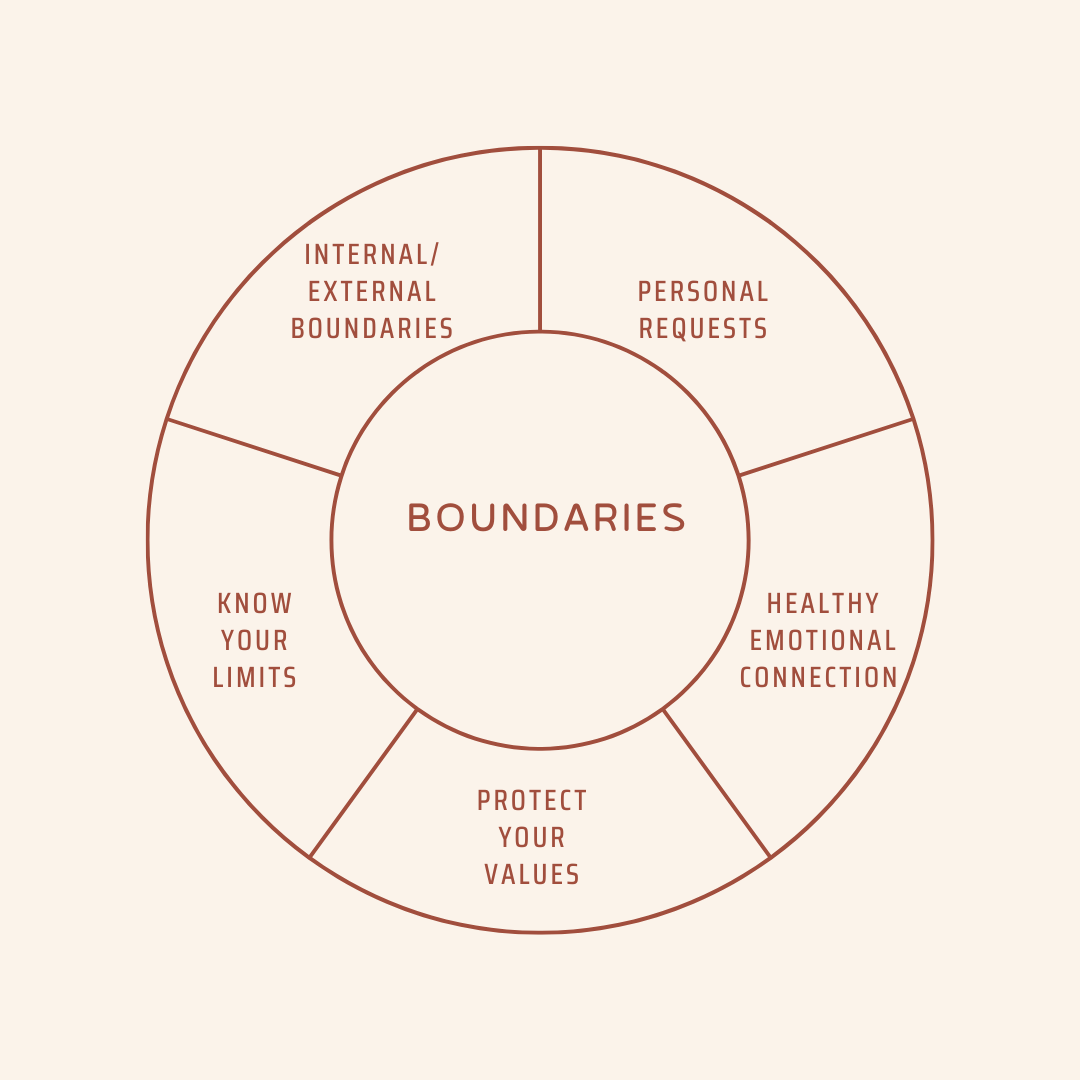
Do you wish you could be more assertive and set better boundaries in your relationships?Assertiveness is a skill that can be learned and practiced. One way to get to assertiveness is to understand yourself better and learn why boundaries are necessary. Assertiveness is about asking for your needs to be met, making requests, and being able to tell others about who you are. Boundaries are used to protect us, create connections, filter out unwanted energy, and help us learn more about who we are. Do you wonder why it can be difficult to set boundaries? Boundaries are difficult to set when we aren’t clear about what we need. Boundary setting comes easier after we learn more about what safety means, how we protect ourselves, and what our limits are. Let’s talk about limits. I’ll use being introverted as an example to show that once you know more about yourself, you will know what boundaries to set and why. Introverts need more alone time than extroverts, as this helps them to recharge their battery, aka energy. So, for instance, when a friend asks you to go to brunch the morning after you were out until 3 a.m. with friends, you will know that saying yes to brunch is a bad idea and will not feel good to you because you know your limit and you know you have to rest. Saying no is the boundary-setting technique you will learn to protect your energy and take care of yourself. The way to guide yourself to being assertive and setting boundaries is to use information from your primary relationships, your nervous system, the resentments you hold, and your values to create a map of what you need and who you are. Below I have created a list of 5 categories for you to do just that, begin to create a map of yourself, the more self-aware you are the more you will know what boundaries to set and when. Childhood woundsChildhood wounds come from primary relationships, these are your caregivers, parents, and extended family members who modeled relationships when you were small. They were responsible for you when you weren’t able to care for yourself. In childhood, because we rely so heavily on the adults in our lives, we leave ourselves unknowingly open to being emotionally hurt by them. To gather more information about what your childhood wounds are, here are a few questions to ask yourself.Use this as your check-in, where you may have experienced emotional pain in childhood might be where your childhood wounds live: How did you receive love when you were a child, was it less than nurturing? How did your parent(s) connect to you, were they distracted, overbearing, or busy? Did you have to focus more on other people when you were younger, your mother’s emotions, and your sibling’s irritability? Did you feel protected by your parents? Think about your answers, are they attached to any emotional pain or discomfort?Childhood wounds are connected to our safety. When there was less than nurturing parenting in our past we can create adaptive strategies as adults to protect ourselves. These strategies usually show up as behaviors that keep us from being hurt by others. When you can identify ways you felt unsafe when you were a child you can begin to see how you protect yourself today. Do you get defensive when someone is critical because you were often criticized as a child? Do you try to be perfect to avoid being abandoned because one parent took their love away from you when you didn’t do as they wanted you to? There is power in learning how you protect yourself from hurt. This allows you to learn internal boundaries, they generate safety so that you aren’t hurt by others in the same way you were when you were younger. You get to give yourself the safety you didn’t receive instead of spending your energy on protecting yourself from potential pain. How you avoid confrontationTo learn more about how you avoid confrontation is to learn more about your nervous system. When our body senses signs of danger, our nervous system takes over. When we become afraid our bodies react to that fear through an autonomic response. This can be flight, fight, freeze, or fawn. Fawn shows up as people-pleasing, bargaining, deferring, or other befriending behaviors to get through a confrontation. Fight response can be aggressiveness, using anger or frustration to shut down a conversation, or deflecting away from the topic. Flight can look like avoidance, running away from danger, procrastination, putting things off, and hoping they will go away on their own. The freeze response is not knowing what to say, being unable to explain yourself, your mind going blank, and stumbling over your words.Here are some questions for you to consider further: Do you tell someone what they want to hear? Do you agree or just say yes, because it’s easier? Do you find a way out of saying yes or no? Do you have a backup plan for how to get out of unwanted commitments? Does your mind go blank and you don’t know what to say? Do you get irritated or upset quickly? Do you use anger as leverage in conversation?You can design the boundaries needed to manage conflict once you know how your nervous system is activated. For example, if you predominantly find yourself in the fight response; you can take breaks to find your calm and center and then reengage with the conversation. If you find yourself in the freeze response, you can acknowledge you are overwhelmed and breathe deep breaths to give space to the conversation and generate the next thing to say. ResentmentsResentments are the arrows that point us toward our unmet needs. When you create a story in your mind about the reasons someone failed or disappointed you, like “I don’t matter to them,” this is the indicator pointing you to your need. You may have a need to matter, to be seen or feel heard by someone. This need may be